Managed sourcing from Bangladesh, for export and for buyers at home
Get it sourced

HVAC and cold chain · Dehumidifiers

Warehouse dehumidifier supplier in Bangladesh

Roptan is your warehouse dehumidifier supplier in Bangladesh. Tell us the store, its temperature, the goods and the humidity their owner allows: we source refrigerant or desiccant units from verified sellers, compare ratings on one condition and deliver to site.

  • Verified sellers
  • Checked before it ships
  • Delivered by Roptan

Get warehouse dehumidifiers sourced

Prefer to deal with suppliers yourself? Post it on the requirement board

Buying warehouse dehumidifiers in Bangladesh

A warehouse dehumidifier is a large refrigerant or desiccant unit that keeps a store dry enough for the goods in it. Hygroscopic goods such as coffee, cocoa, nuts and grain draw moisture from damp air and can mould or rot. In Bangladesh the June to September monsoon is when stores struggle most, and Dhaka's monthly mean humidity usually peaks at about 83 percent.

The choice of machine follows from two facts: how warm the store is and how dry the goods need it. As your warehouse dehumidifier supplier in Bangladesh, Roptan gets those two facts in writing, asks verified sellers to rate capacity at a stated condition, checks the safety report and delivers.
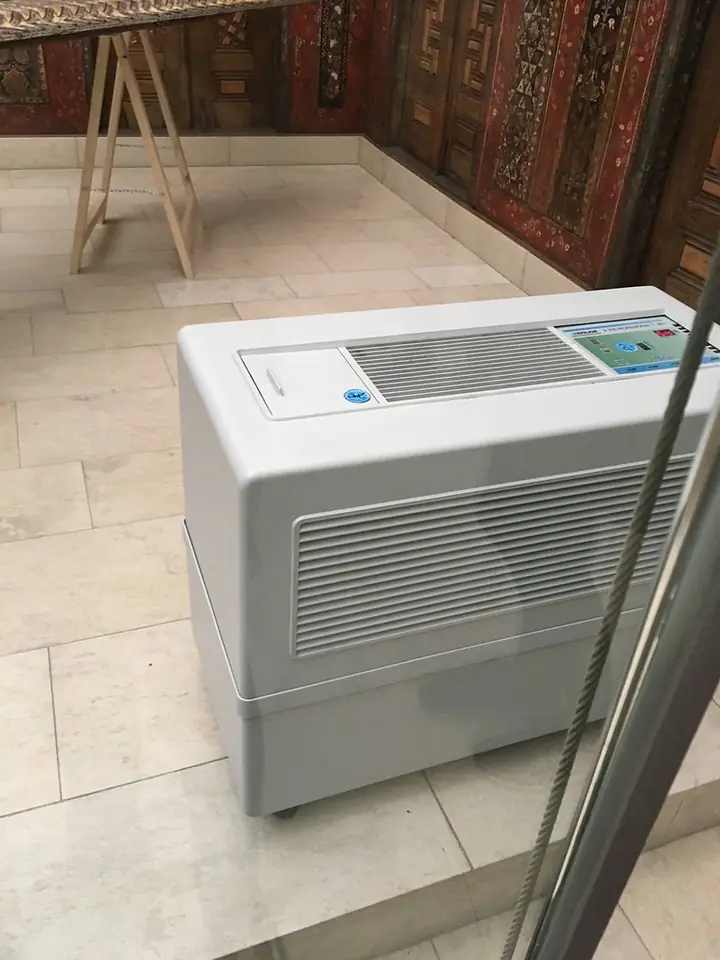
Kinds of warehouse dehumidifier

Refrigerant units for ambient stores

They work well in warm, humid stores with high moisture loads, typically 20 °C and above with humidity of about 50 percent or more. Ambient Bangladesh warehouses usually sit in that band in the monsoon.

Desiccant units for cool and cold stores

Refrigerant coils freeze in cool air, so desiccant units are the usual choice for cold storage and for low humidity targets.

Drying units after water gets in

After a flood or a roof leak, wet materials should be dried within 24 to 48 hours to avoid mould, so the unit must be sized for drying, not only for holding.

How to specify a warehouse dehumidifier

The goods' own limit
Goods specifications usually set their own storage humidity. Ask the owner of the goods for a number in writing before any capacity is chosen.
Mould control
Where no goods limit exists, the US EPA advises indoor relative humidity below 60 percent, ideally 30 to 50 percent.
Store temperature
If incoming air has a dew point below about 10 °C, a refrigerant coil runs below freezing and ices. That points a cool store to desiccant.
Store volume and openings
Give the store volume in m³, the doors and how often they open, and any fans that bring in outdoor air. In the monsoon the moisture that comes in with outdoor air is usually the main load.
Cold surfaces
Roof sheets, floors and walls colder than the air's dew point gather condensation. ISO 13788:2012 calculates the surface temperature needed to avoid it.
Supply
Large units usually run on three phase at 50 Hz, nominally 380 to 400 V. Check the data plate against the supply.
Logger positions
Plan calibrated loggers at the worst spots, such as corners, near doors and low stacks, not only in the middle of the floor.

Ratings, safety and records for a warehouse

Stated rating condition
US tests rate at 65 °F (18.3 °C) and 60 percent RH; many makers in Asia quote 30 °C and 80 percent, which reads larger. Compare every offer on one condition.
EN 810
The European standard for compressor dehumidifiers: rating tests, marking and a technical data sheet. Ask which edition the data sheet follows.
Safety test report
IEC 60335-2-40 covers dehumidifier safety, but its title says household and similar appliances. For a large unit, ask which standard the report cites.
ISO 13788:2012
The calculation of internal surface temperature to avoid critical surface humidity. Ask whether a cold roof or floor was checked with it.
ISO/IEC 17025 calibration
Loggers calibrated by an accredited laboratory, with certificates, so the humidity record can be trusted.

What moves the price of a warehouse dehumidifier

  • The store's temperature and the goods' limit, which decide refrigerant or desiccant.
  • A drying duty after water damage, which needs more capacity than holding a dry store.
  • The number of loggers and alarms needed to cover corners, doors and low stacks.
  • Three phase electrical work, and any fix for cold roof or floor surfaces.

Lead times and delivery

No typical lead time is given here. Large units are usually imported, so a model in a seller's stock arrives sooner than one built to order, which waits for shipping and clearance at Chattogram. A desiccant unit, ducting across a large store or three phase work on site can add time. Roptan confirms the dates and any minimum in the quote.

We deliver to site anywhere in Bangladesh. The seller places the units, connects power and drains, and commissions them. Calibrated loggers go at the worst spots, so the record shows the whole store, not one corner. Handover includes the rating data, the safety test report, logger certificates, manuals and a VAT invoice (Mushak 6.3).

What we check for this order

  • Goods limit in writingWe ask the owner of the goods for the storage humidity they need, so the target is theirs and not a guess.
  • One rating conditionWe ask every seller for capacity and power at one stated temperature and humidity, close to the store's.
  • Safety standard namedWe ask which standard the safety test report cites for a large unit, and that it names the model.
  • Logger calibration and placementWe check logger certificates from an ISO/IEC 17025 accredited lab and that loggers sit at the store's worst spots.

Questions buyers ask

What humidity should my warehouse hold?

The figure your goods need, from their owner or specification. Where none exists, the US EPA advises below 60 percent, ideally 30 to 50 percent, to limit mould. Limits differ by product, so take the number from the goods' owner.

How big a unit does my warehouse need?

Not from floor area alone. The seller works it out from the store volume, the air that comes in through doors, gaps and fans, the goods and the humidity to hold. Give those, then ask the seller to show the calculation and the temperature and humidity the capacity is rated at, so offers compare on one basis.

Why is water dripping from my warehouse roof?

Usually because the roof sheets are colder than the dew point of the air under them, so moisture condenses on them. ISO 13788:2012 gives the calculation for the surface temperature that avoids it.

Water got into the store after a storm. What now?

Dry it fast: the US EPA says wet materials should be dried within 24 to 48 hours to avoid mould. Ask for a unit sized to dry the store, not only to hold it dry.

Which kind suits a cold store?

A desiccant unit, usually. In a cool store the incoming air's dew point can be below about 10 °C, so a refrigerant coil ices and stops drying during defrost.

How soon will I hear back about dehumidifiers?

Within 48 hours of a complete requirement, with a price and a delivery date. A requirement is complete when it has the capacity, where it is needed and by when.

Who do I deal with?

With Roptan, when Roptan manages the order: we buy from the verified seller and deliver to you. With the supplier directly, when you post on the requirement board and choose a quote yourself.

Other dehumidifier products

Each product type has its own page as it is published; until then its card opens the category form.

All dehumidifiers