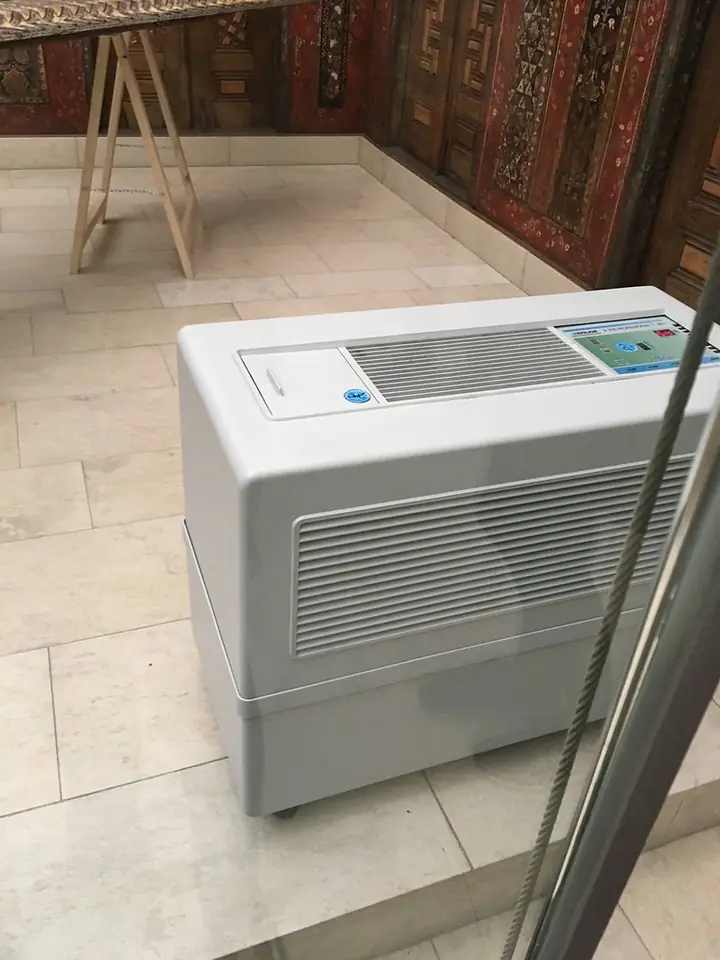
Buying portable dehumidifiers in Bangladesh
A portable dehumidifier is a plug-in unit that dries the air in one room. Most are refrigerant units: a fan draws air over a cold coil, water condenses into a tank or runs to a drain, and the condenser coil warms the air again. Homes, offices, labs, shops and small stores buy them for the monsoon, when Dhaka's monthly mean humidity usually peaks at about 83 percent.
The hard part is comparing offers: one seller quotes litres per day at a warm, wet test condition, another at a cool one. As your portable dehumidifier supplier in Bangladesh, Roptan asks every verified seller for capacity at one stated condition, checks the safety report for the exact model and delivers the units.
How to specify a portable dehumidifier
- Room temperature
- Give the temperature the unit will run at. An air-conditioned room or a cool night can fall below the band where a refrigerant unit works well.
- Target humidity
- The US EPA advises keeping indoor relative humidity below 60 percent, ideally 30 to 50 percent, to keep mould from growing.
- Capacity and its test condition
- Ask for litres per day with the temperature and relative humidity it was measured at, plus power input. A capacity without its condition tells you little.
- Drainage
- In a warm, humid room the tank usually fills in 8 to 12 hours. For an unattended store, ask for a drain hose connection or a condensate pump.
- Frost or ice sensor
- In cooler rooms ice builds on the evaporator coil and blocks airflow. Better units have a frost sensor; ask whether the quoted model does.
- Power supply
- Most portable units run on single phase mains at 50 Hz. Check the voltage and frequency on the data plate match the supply.
Test conditions, safety and noise data
- AHAM DH-1-2022 and the US DOE method
- Both rate portable units with entering air at 65 °F (18.3 °C) and 60 percent RH. The older US condition, still printed on some data sheets, was 80 °F and 60 percent.
- The maker's own condition
- Many makers selling in Asia quote capacity at 30 °C and 80 percent RH, which gives a larger figure. In a Hong Kong consumer test, half the samples measured well below their claim at that condition.
- IEC 60335-2-40 with IEC 60335-1
- The electrical safety standard for dehumidifiers. Ask for the test report or certificate for the exact model; US data sheets may cite UL 474 or UL 60335-2-40 instead.
- EN 810
- The European standard for compressor dehumidifiers: rating tests, marking and a technical data sheet. Ask which edition the seller's data sheet follows.
- EN 12102-1:2022
- Sets how the sound power of compressor dehumidifiers is found. The 2017 edition was withdrawn in 2022; ask for a figure to the current one.
Lead times and delivery
No typical lead time is given here: it depends on stock. A model a seller holds in Bangladesh arrives sooner than one imported to order, which waits for shipping and customs clearance. A specific capacity or a built-in pump can add time. Roptan confirms the dates and any minimum in the quote.
We deliver anywhere in Bangladesh. A portable unit needs only a socket, a drain route and a closed room. We show where the hose fits and how the filter comes out, since filter and coil cleaning is the usual service task. Handover includes the manual, warranty card and a VAT invoice (Mushak 6.3).
Questions buyers ask
Why does my unit remove less water than the box says?
Usually because the box figure was measured in warmer, wetter air than your room. A capacity at 30 °C and 80 percent reads larger than the same unit at 18.3 °C and 60 percent, the US condition. Ask for capacity near your room's conditions.
Will a portable dehumidifier work in an air-conditioned room?
A refrigerant unit loses output as the room cools below about 20 °C, and in cool air its coil can ice up and stop drying while it defrosts. For a room that stays cool, choose a model with a frost sensor or a portable desiccant unit.
How often will I have to empty the tank?
In a warm, humid room the tank usually fills in 8 to 12 hours, so about twice a day in the monsoon. Many units accept a hose to a floor drain, or a condensate pump where no drain is near.
Is a small thermoelectric dehumidifier enough for a room?
Usually not. Thermoelectric units are inefficient, so they are made only in very small sizes for cupboards and closets. For a room or store, choose a refrigerant unit.
How soon will I hear back about dehumidifiers?
Within 48 hours of a complete requirement, with a price and a delivery date. A requirement is complete when it has the capacity, where it is needed and by when.
Who do I deal with?
With Roptan, when Roptan manages the order: we buy from the verified seller and deliver to you. With the supplier directly, when you post on the requirement board and choose a quote yourself.