Managed sourcing from Bangladesh, for export and for buyers at home
Get it sourced

HVAC and cold chain · Dehumidifiers

Desiccant dehumidifier supplier in Bangladesh

Roptan works as your desiccant dehumidifier supplier in Bangladesh. Tell us the room temperature, the dew point or humidity you must hold and the heat you can supply: we source from verified sellers, check the rating basis and deliver to site.

  • Verified sellers
  • Checked before it ships
  • Delivered by Roptan

Get desiccant dehumidifiers sourced

Prefer to deal with suppliers yourself? Post it on the requirement board

Buying desiccant dehumidifiers in Bangladesh

A desiccant dehumidifier dries air by bonding moisture to a water-loving material such as silica gel, instead of cooling the air to condense it. Larger units then drive the moisture off with hot air and send that humid air outside. Pharmaceutical plants, cold stores, cleanrooms and stores for goods such as coffee, cocoa, nuts and grain buy them, because they suit cool rooms and very dry targets.

Desiccant units are not rated like compressor units, so offers are easy to misread. As your desiccant dehumidifier supplier in Bangladesh, Roptan asks verified sellers for capacity at stated process-air conditions, the outlet dew point and the reactivation power, checks the exhaust route and the safety report, then delivers.
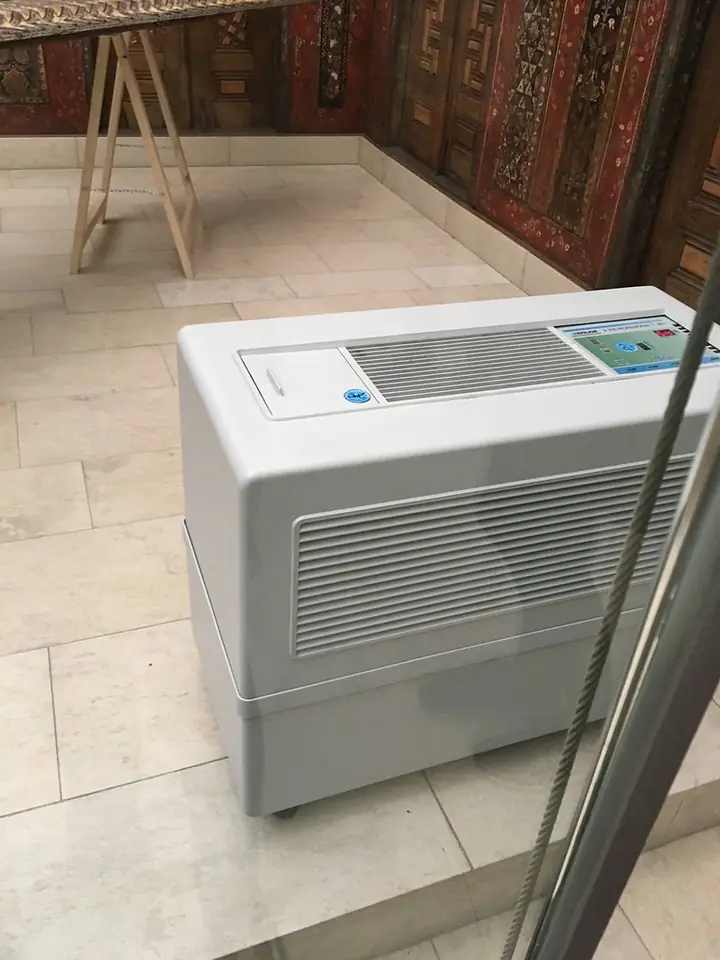
Kinds of desiccant dehumidifier

Regenerating units

Commercial units that dry the sorbent with hot air and expel the humid air outside the room. A project purchase for a store or production room is this kind.

Single-use cartridge units

Cheap domestic units that hold a cartridge, gel or powder which is replaced once saturated. Choose them for a cupboard or a small closed space, not a room that needs a target.

Silica gel units

Silica gel is the most common desiccant: inert, non-toxic and insoluble in water. Ask the seller which material the unit uses and how long it lasts.

Molecular sieve units

A second family of desiccant materials, typically zeolites. Ask why the seller proposes a sieve over silica gel for your duty.

How to specify a desiccant dehumidifier

Dew point, not only RH
State the outlet or room dew point you must hold as well as relative humidity. Desiccant units are chosen where a very low, precise dew point matters.
Room temperature
Absorption units suit high humidity at low temperature, where refrigerant coils freeze. Give the temperature the room runs at, day and night.
What the room holds
Name the use: pharmaceutical production, cold storage, a cleanroom, or hygroscopic goods such as coffee, cocoa, nuts and grain, which mould and rot in damp air.
Reactivation heat
Regeneration needs heat. State what you can supply, electric, steam or fuel, and the power or connection available at the unit.
Exhaust route
The humid reactivation air goes outside the room, so plan a duct route to outdoors before choosing where the unit stands.
Cleanroom class
ISO 14644-1:2015 classifies air cleanliness by particle count only. If the room is a cleanroom, give its class and the humidity target separately.
Inlets and supply
Ask for the filter class to ISO 16890-1 and the IP code to IEC 60529 on the process and reactivation inlets, and a unit rated for 50 Hz.

Ratings, safety and measurement for desiccant units

Rating basis
EN 810 covers compressor units only, so it does not rate a desiccant unit. Ask for capacity at stated process-air temperature, RH and airflow, the outlet dew point and the reactivation power.
Safety test report
IEC 60335-2-40 covers dehumidifier safety, but its title says household and similar appliances. For a large unit, ask which standard the report cites.
ISO 14644-1:2015
Classifies cleanroom air by particle concentration. It does not set humidity, so the humidity target has to be written into the brief separately.
Calibrated measurement
At low dew points a small sensor error is a large share of the reading. Use instruments calibrated by an ISO/IEC 17025 accredited laboratory.

What moves the price of a desiccant dehumidifier

  • The outlet dew point and process airflow you need, which set the size of the unit.
  • The reactivation heat source, electric, steam or fuel, and the work to connect it.
  • Ducting for the process air and for the humid exhaust to outdoors.
  • Filters and enclosures on both inlets, and any cleanroom requirements.

Lead times and delivery

No typical lead time is given here. Desiccant units are usually imported, so a model in a seller's stock arrives sooner than one built to a duty. A low dew point, a steam or fuel reactivation connection, or cleanroom filters can add time, as can shipping and clearance at Chattogram. Ducting and heat connections on site often set the start date. Roptan confirms the dates and any minimum in the quote.

We deliver to site anywhere in Bangladesh. The seller places the unit, runs the process and exhaust ducts, connects the reactivation heat and power, and commissions it, reading dew point and room humidity on calibrated instruments. Handover includes the rating data, the safety test report, manuals, warranty papers and a VAT invoice (Mushak 6.3).

What we check for this order

  • Rating on stated conditionsWe ask each seller for capacity at stated process-air temperature, RH and airflow, with outlet dew point and reactivation power.
  • Exhaust and heat agreedWe confirm the exhaust duct route to outdoors and the reactivation heat supply before the order, since both shape installation.
  • Safety standard namedWe ask which standard the safety test report cites, and that it names the model quoted.
  • Calibrated instrumentsWe ask for dew point and humidity readings on instruments calibrated by an ISO/IEC 17025 accredited lab, since low readings magnify error.

Questions buyers ask

When do I need a desiccant unit rather than a refrigerant one?

When the room is cool or the target is very dry. Absorption units suit high humidity at low temperature, and industry uses them to reach humidity below 35 percent. Refrigerant coils freeze in cool air and cannot reliably reach very low humidity.

Where does the water go?

A regenerating unit does not fill a tank. Hot reactivation air drives moisture out of the desiccant and carries it outside the room as humid air, so the unit needs an exhaust duct to outdoors.

Silica gel or molecular sieve?

Silica gel is the most common desiccant. Molecular sieves, typically zeolites, are a second family. The right one depends on the duty, so ask the seller why they propose it and how long the material lasts.

Does a cleanroom class cover humidity?

No. ISO 14644-1:2015 classifies air cleanliness by particle concentration only. A pharmaceutical or cleanroom brief needs the cleanliness class and the humidity or dew point target stated separately.

Are cartridge dehumidifiers enough for a store?

No. Single-use cartridge, gel or powder units are cheap domestic products for small closed spaces. A store or production room needs a regenerating unit sized to a stated target.

How soon will I hear back about dehumidifiers?

Within 48 hours of a complete requirement, with a price and a delivery date. A requirement is complete when it has the capacity, where it is needed and by when.

Who do I deal with?

With Roptan, when Roptan manages the order: we buy from the verified seller and deliver to you. With the supplier directly, when you post on the requirement board and choose a quote yourself.

Other dehumidifier products

Each product type has its own page as it is published; until then its card opens the category form.

All dehumidifiers