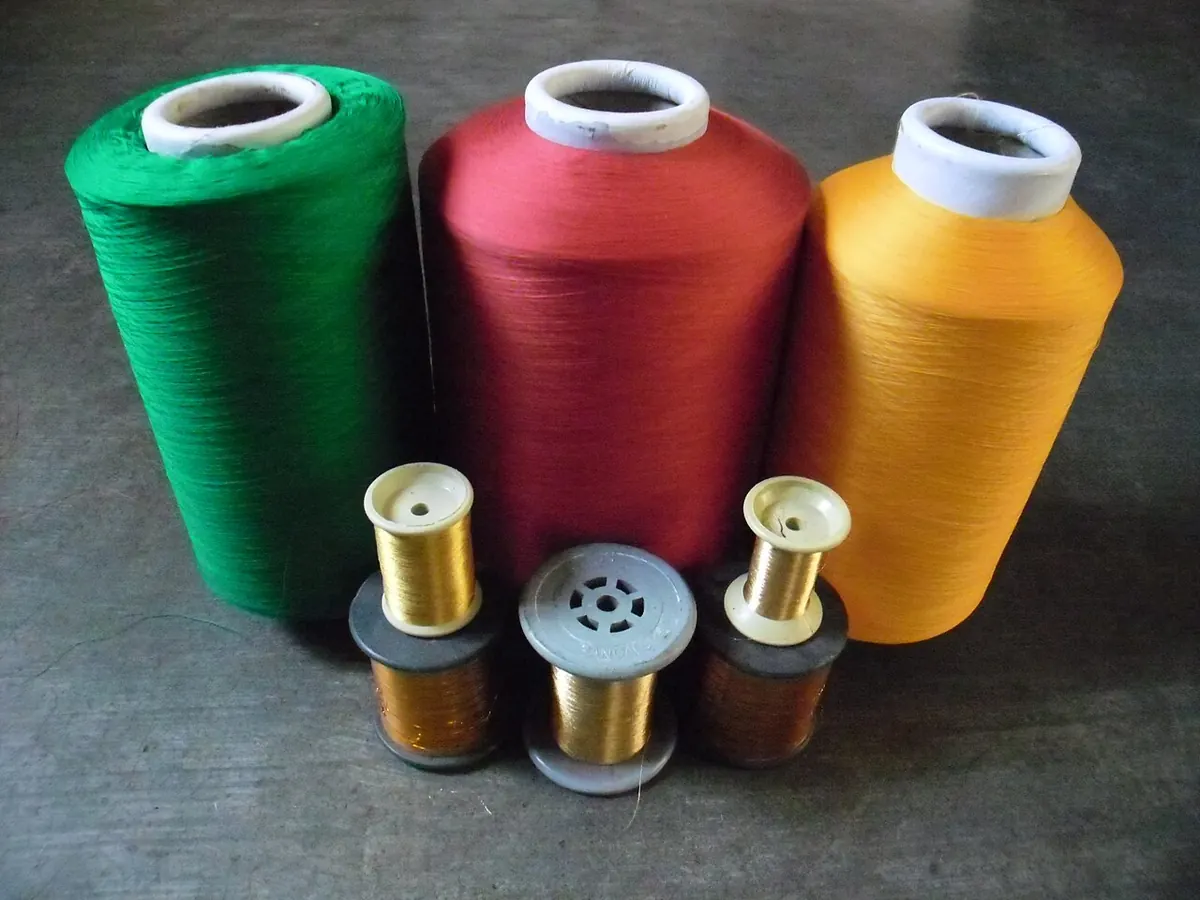
Buying filament yarn in Bangladesh
Filament yarn is made of continuous filaments, not short spun fibre. Smooth filament yarn does not lint, resists pilling and has more lustre than spun yarn; texturing adds bulk and stretch. Polyester filament for knitting is often 75 or 150 denier, and synthetic filament yarn is among the main yarns Bangladesh's textile industry imports.
Whichever filament yarn manufacturer in Bangladesh or importer supplies it, the order turns on notation, shrinkage and dye uptake. Roptan sources from verified mills and traders, writes the notation and test limits into the order, checks the packages and the lot report, and delivers. You deal with Roptan only.
How to brief a filament yarn manufacturer in Bangladesh
- Denier and filament count
- Linear density in denier (grams per 9,000 m) or dtex, over the filament count, written like 75D/36F. ISO 1139 notation uses tex and excludes textured yarn.
- Polymer, form and texturing
- Polyester or nylon; POY, FDY, DTY or ATY; and for textured yarn the method, since false-twist and air-jet yarns differ in stretch.
- Lustre and cross-section
- Lustre depends on the delustrant in the fibre and on the twist. Round filaments pack tightly; non-round ones give more cover and air permeability.
- Twist and intermingling
- Filament yarn usually reaches its highest strength at low twist, about 3 to 6 turns per inch. ISO 2061 does not suit intermingled yarn, so name the twist test.
- Finish and static
- The oil level sets yarn friction and, on 100 percent synthetic yarn, static discharge. State the finish, and for anti-static yarn the resistance test, ISO 24180:2021.
Tests that fit filament yarn
- ISO 2062, not ISO 6939
- Single-end breaking force and elongation apply to filament yarn. Skein breaking, the basis of lea strength, is not recommended for it, so do not ask a filament seller for CSP.
- ISO 18066:2015
- Boiling-water shrinkage of flat and textured multifilament yarn under 3,000 dtex, by an automatic method. It does not apply to POY.
- ISO 5688:2024
- Crimp of synthetic textured filament yarn, by a hot-air or a hot-water method. Name the method and keep it the same for every lot.
- ISO 20920:2018
- Dye uptake of cationic-dyeable modified polyester, staple or filament but not POY. Use it when the order specifies a cationic-dyeable grade.
Lead times and delivery
Yarn a trader already holds in stock can move sooner than yarn imported for the order, which waits for the letter of credit, shipping and port clearance at Chattogram; in 2026 banks have been slow to open letters of credit for yarn. Roptan confirms the dates and the minimum in the quote.
We deliver to your knitting or weaving unit, cartons marked with polymer, form, denier, filament count and lot. Polyester and nylon on plastic cones can be steam-conditioned before packing, so ask for the moisture at packing. Papers include the lot test report, packing list by lot and a VAT invoice (Mushak 6.3).
Buying filament yarn for export
Where a seller can supply it for export, filament yarn ships under HS heading 5402, synthetic filament yarn, with nylon and polyester on separate lines and textured yarn apart from flat; viscose filament is under 5403, sewing thread under 5401. We quote FOB Chattogram with the lot report, packing list and certificate of origin.
Questions buyers ask
Does filament yarn need an evenness test?
Less than spun yarn. Continuous filament has little variation in linear density, so bands in a filament knit usually come from uneven dye uptake. ISO 16549:2021 still covers filament yarn from 1 to 600 tex where an evenness figure is wanted.
How do I compare denier with tex?
Divide denier by 9: denier is grams per 9,000 m and tex grams per 1,000 m. Spun yarn in Ne converts as 590.5 divided by Ne. Put both quotes in tex before comparing filament with spun yarn.
Can I ask for CSP on filament yarn?
No. CSP comes from the skein, or lea, breaking test, and ISO 6939 says that method is not recommended for filament yarn. Ask for single-end tenacity and elongation to ISO 2062 instead, with the test speed stated on the report.
Is filament yarn made in Bangladesh?
Much of it is imported: USDA lists synthetic filament yarn among the main yarns the textile industry brings in. Roptan sources from verified mills and traders who hold or import it, and checks every lot the same way.
How soon will I hear back about cotton and synthetic yarn?
Within 48 hours of a complete requirement, with a price and a delivery date. A requirement is complete when it has the quantity, where it is needed and by when.
Who do I deal with?
With Roptan, when Roptan manages the order: we buy from the verified seller and deliver to you. With the supplier directly, when you post on the requirement board and choose a quote yourself.