Managed sourcing from Bangladesh, for export and for buyers at home
Get it sourced

HVAC and cold chain · Exhaust fans

Axial fan supplier in Bangladesh

Roptan works as your axial fan supplier in Bangladesh. Give us the airflow, the pressure and where the fan goes: we source propeller, cased or jet fans from verified sellers, check the duty point on a tested curve and deliver.

  • Verified sellers
  • Checked before it ships
  • Delivered by Roptan

Get axial fans sourced

Prefer to deal with suppliers yourself? Post it on the requirement board

Buying axial fans in Bangladesh

An axial fan moves air along its shaft, like a propeller. It moves large volumes against modest resistance and is usually more efficient than a centrifugal fan at that work, so it serves warehouse exhaust, shed ventilation, cooling and car park air movement. Standard axial fans usually work up to about 800 Pa. Typical buyers are factories, warehouses and building developers across Bangladesh.

Choosing the duty is where most of the risk sits: an axial fan pushed onto the unstable left part of its curve stalls, surges and vibrates. As your axial fan supplier in Bangladesh, Roptan sends one brief to verified sellers, checks each duty point on a tested curve and the test method behind it, and delivers with fitting through the seller.
Kinds of axial fan

Propeller fans

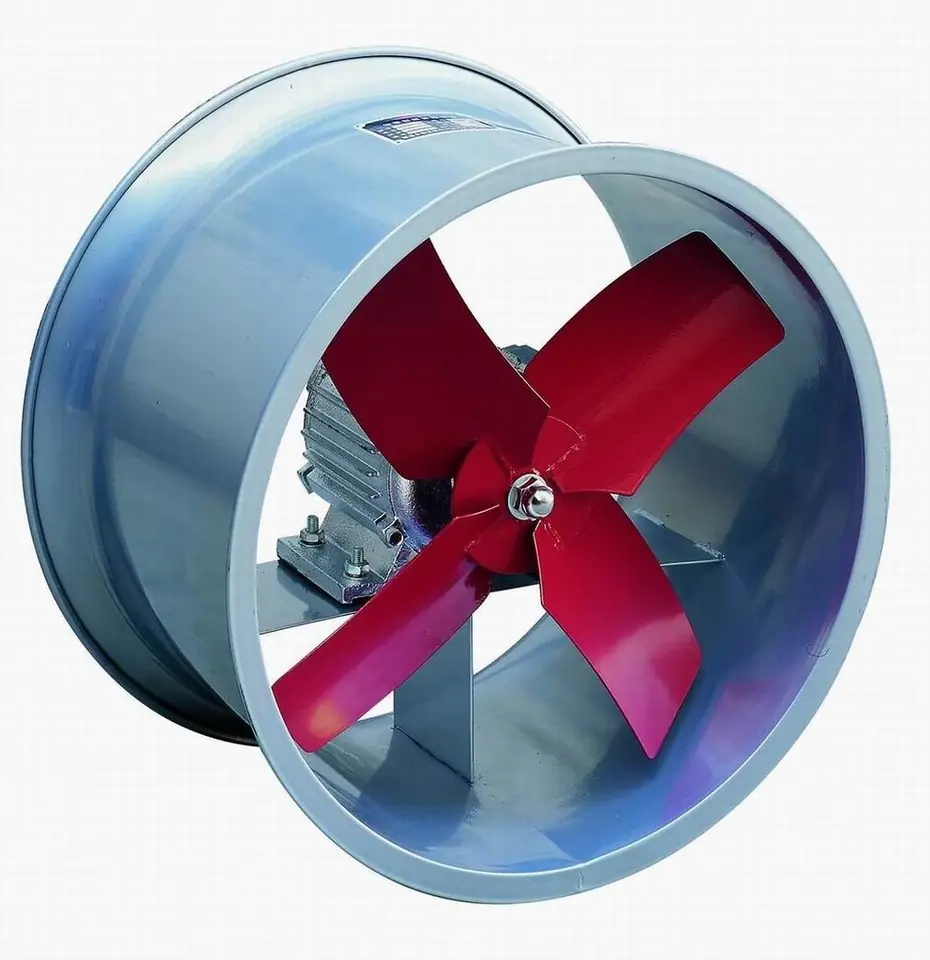
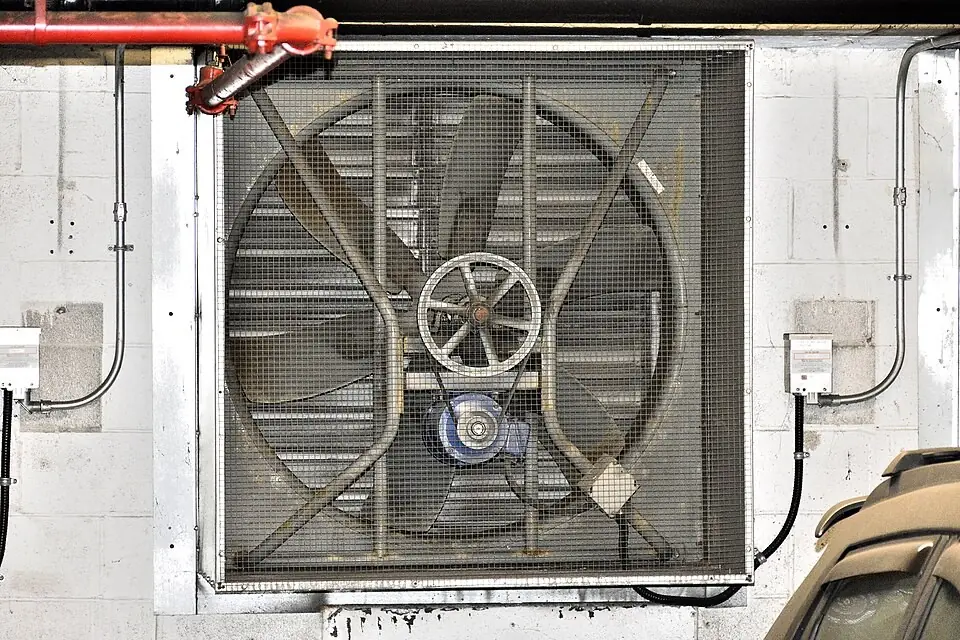
An open propeller in a plate, ring or box, for walls and roofs with little or no duct. Choose them for general shed and warehouse exhaust against low resistance.

Cased axial fans for ducts

An axial impeller in a cylindrical case that fits into a duct run, usually for moderate duct losses. Choose them for ventilation ducts and plant rooms where pressure stays well inside an axial fan's range.

Jet or impulse fans

Fans that push air or smoke along a car park or tunnel towards the exhaust point. They are tested to ISO 13350, not ISO 5801. Choose them where air or smoke must travel along a long space.

Smoke-extract axial fans

Axial fans built as powered smoke and heat control ventilators, set in a roof, upper wall, duct or plant room. Choose them only within a designed smoke-control system.

How to specify an axial fan

Airflow
In m³/h, from room volume times air changes per hour. Commonly used rates run from 2 to 4 for ordinary factories to 20 to 30 for repair garages.
Pressure and the 800 Pa line
Add up duct, louvre and filter losses in Pa. Standard axial fans usually work up to about 800 Pa; above that, or with filters in the path, ask for a centrifugal fan.
Duty point on the curve
Pick a duty well inside the stable part of the published curve. Too little flow for the pressure pushes the fan onto the unstable left part, where it stalls, surges and vibrates.
Where air comes in
Exhaust needs matching intake. Show the openings that let replacement air in, or the fan works against a sealed space.
Motor and enclosure
Ask for the IE class to the current IEC 60034-30-1 edition and an IP first digit of 5, dust protected, or 6 where lint or dust is heavy.
Speed control
Inlet or outlet vanes can be 6 to 10 per cent less efficient than a variable frequency drive. Ask for a drive on fans that run long hours at part load.

Standards and tests for axial fans

ISO 5801:2017
The test method for airflow, pressure, power and efficiency on standard airways, for most fan types. Ask which method produced the curve.
EN ISO 13350:2015
The performance test for jet fans. A jet fan offer should cite it rather than ISO 5801.
EN 12101-3:2015
Covers powered smoke and heat control fans, including impulse or jet fans. It applies only where the fan is part of a smoke-control system.
ISO 13349-1 and ISO 13349-2:2022
Fan vocabulary and categories, which replaced the withdrawn ISO 13349:2010. A datasheet that still cites the 2010 edition is out of date.
ANSI/AMCA 204
Balance quality and vibration levels for fans. Ask for the balance grade and start-up vibration readings on large impellers.

What moves the price of an axial fan

  • Diameter and the airflow needed at your pressure, which set blade and motor size.
  • Construction: open propeller, box or cylindrical case.
  • Blade material and finish for humid, dusty or corrosive air.
  • Drive and control: direct or belt drive, speed steps or a variable frequency drive.
  • Smoke-extract certification, or jet fan testing to ISO 13350.

Lead times and delivery

Common propeller and cased fans from a seller's range usually come quickest. Large diameters, special blade materials, certified smoke-extract fans and jet fans with their test papers take longer, and so do large quantities. Roptan confirms the delivery dates and the minimum order in the quote.

We deliver across Bangladesh. Where fitting is in scope, the seller mounts the fan, connects the duct or seals the opening, confirms the airflow direction and checks current and vibration. Handover covers the fan curve and its test method, motor data, any smoke-extract certificate, wiring, warranty and a VAT invoice (Mushak 6.3).

What we check for this order

  • Duty point clear of stallWe check the duty sits well inside the stable part of the published curve, away from its unstable left part.
  • Pressure within rangeWe check your summed pressure suits an axial fan at all, against the roughly 800 Pa working range.
  • Right test standardWe confirm curves cite ISO 5801 or AMCA 210, and jet fan figures cite ISO 13350.
  • Smoke certificateFor smoke-extract duty, we check the EN 12101-3 certificate covers the exact model offered.

Questions buyers ask

Axial fan or centrifugal fan?

Axial for high airflow against low resistance: open walls, roofs and short ducts. Centrifugal for ducted work, filters and pressures beyond an axial fan's range, usually about 800 Pa. A centrifugal fan builds more pressure for the same air volume but is typically noisier.

Why does our axial fan vibrate and roar?

Often because it runs on the unstable left part of its curve, with too little airflow for the pressure it faces. Flow turns unsteady, the fan stalls and surges, and vibration rises. Check for blocked inlets, closed dampers or added duct, then compare the real duty with the curve.

What is a jet fan, and how is it tested?

A jet or impulse fan moves air or smoke along a car park or tunnel. It is tested to ISO 13350, not ISO 5801, and where it is part of smoke control it also comes under EN 12101-3. Ask for both papers where they apply.

Does slowing an axial fan save much power?

Yes. Power follows the cube of speed, so at 63 per cent speed a fan draws about 25 per cent of full power. A variable frequency drive does this more efficiently than vanes, which can lose 6 to 10 per cent.

How soon will I hear back about exhaust fans?

Within 48 hours of a complete requirement, with a price and a delivery date. A requirement is complete when it has the capacity, where it is needed and by when.

Who do I deal with?

With Roptan, when Roptan manages the order: we buy from the verified seller and deliver to you. With the supplier directly, when you post on the requirement board and choose a quote yourself.

Other exhaust fan products

Each product type has its own page as it is published; until then its card opens the category form.

All exhaust fans