Managed sourcing from Bangladesh, for export and for buyers at home
Get it sourced

Apparel and textiles · Textile testing and colour lab

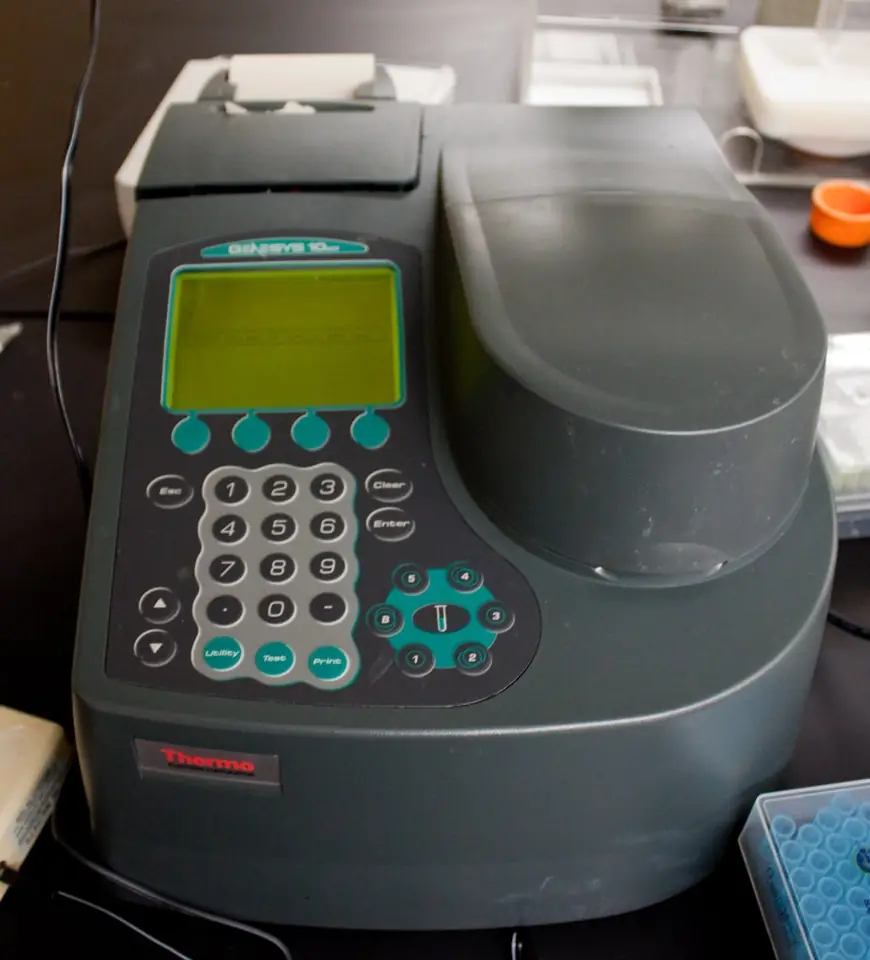
Spectrophotometer supplier in Bangladesh

Tell us how you will use it: recipes, pass or fail, or floor checks. As a spectrophotometer supplier in Bangladesh, Roptan sources the instrument, software and calibration set from verified sellers, checks them against your buyers' requirements, and arranges installation through the seller.

  • Verified sellers
  • Checked before it ships
  • Delivered by Roptan

Get spectrophotometers sourced

Prefer to deal with suppliers yourself? Post it on the requirement board

Buying spectrophotometers in Bangladesh

A spectrophotometer measures how much light a sample reflects at each wavelength of the visible spectrum and turns that into colour numbers, the basis for recipes, tolerances and pass or fail. In a Gazipur knit composite mill studied by students, an imported spectrophotometer built recipes from the standard sample and checked the CMC value. USDA counted 342 dyeing, printing and finishing facilities in Bangladesh in April 2026, from BTMA data.

Two instruments can disagree on one swatch when aperture, mode or UV setting differ, and a shade that passes in your lab can then fail in the buyer's. A spectrophotometer supplier in Bangladesh has to match the way the buyer measures. Roptan sources from verified sellers, checks geometry, apertures, UV control and software, and confirms the calibration route. You deal with Roptan only.
Kinds of spectrophotometer

Benchtop sphere instruments

A d/8 integrating sphere lights the sample from all directions and reads with the gloss component included (SCI) or excluded (SCE). It is the geometry for recipe formulation and textured surfaces: the lab instrument.

Portable spectrophotometers

Hand-held units for factory or field work; a dyehouse paper says benchtop units normally have more functions for shade control. Choose one for checks on the floor.

45/0 instruments

They light the sample from one direction and always exclude the specular component, and ASTM has a separate test method for this geometry. Choose one only if your buyer's standards were measured on 45/0.

UV-controlled models

Fitted with a UV filter, such as a 400 nm cut-off on one range, or sold as UV-filtered variants. Choose one if you dye or finish whites treated with optical brighteners.

How to brief a spectrophotometer supplier in Bangladesh

Geometry and mode
A d/8 sphere that reads both SCI and SCE. One maker says SCI gives the colour of the dye, for recipes, and SCE the surface appearance, for quality checks.
Apertures
Interchangeable plates; makers' ranges run from about 2.5 mm to 26 mm, small for small samples and large for large. Read standard and batch through the same one.
UV control
A controllable UV source for brightened textiles, calibrated by the AATCC EP11 procedure with a textile UV standard.
Inter-instrument agreement
The maker's stated agreement between instruments and how it is verified; ASTM E2214-23 gives the format. It matters when your numbers must match the buyer's lab.
Tolerance settings
Your buyer sets the CMC l:c ratio and the pass limit, so the software must accept both and report against them.
Calibration set
White calibration plate, zero calibration box, green check tile and a target mask for each aperture, with tile serial numbers in the quote.

Colour measurement standards

ISO 105-J03:2009
Calculates the CMC l:c colour difference between two specimens of the same material and lets a tolerance be set. Current after review in 2025; the 1995 edition is withdrawn.
ISO 105-J01:1997 and ISO/CIE 11664-4:2019
J01 sets general principles for measuring surface colour on textiles; 11664-4 specifies CIELAB, the colour space that CMC tolerancing builds on.
AATCC EP6, EP7 and EP11
EP6-2021 covers instrumental colour measurement, EP7-2021e grades colour change by instrument instead of the grey scale, and EP11-2021e calibrates UV content for brightened textiles.
ASTM E1164-23, E308 and D2244-25
Spectrometric data for object colour, computing colour from spectral data in the CIE system, and colour tolerances and differences, a practice that names textile swatches.

What moves the price of a spectrophotometer

  • Form: a benchtop sphere unit or a portable one.
  • Apertures: how many plates come with it, and whether the aperture changes automatically.
  • UV control: a filter or a UV-controlled variant for brightened whites.
  • Agreement: the inter-instrument agreement the maker states and verifies.
  • Software: formulation and quality control modules, seats and the buyer file formats it reads.
  • Support: the warranty, and a calibration plan or service contract.

Lead times and delivery

Time depends on the model, the software licences and the route. An instrument a seller already holds in Bangladesh moves faster than one imported to order, and a UV-controlled variant, extra apertures, software installation and a first calibration on site all need arranging before handover. Roptan confirms the delivery and installation dates in the quote.

Roptan delivers to your lab anywhere in Bangladesh, and the seller installs the instrument. At handover, check that the plates, masks, zero box and cables are present, with the green tile and dust cover if ordered, that the software and licence keys are installed and a first calibration is run, and that a reading of your buyer's reference matches the buyer's lab. You receive the papers and a VAT invoice (Mushak 6.3).

What we check for this order

  • Calibration set and serialsWe check the white plate, zero box, green tile and masks against the quote, with the tile serial numbers.
  • Reading against the buyerWe ask for a reading of your buyer's reference at handover, compared with the buyer's own figures.
  • Tolerance in the softwareWe confirm the software calculates CMC to ISO 105-J03 and accepts your buyer's ratio and pass limit.
  • Service and calibration routeWe ask what the warranty covers, and who calibrates the instrument, and where, once any free first-year checks end.

Questions buyers ask

Is a colorimeter enough for lab dips?

No. A colorimeter is a filter instrument that reads under one light source, so it is not suited to metamerism, colourant strength or recipe work. For lab dips and formulation you need a spectrophotometer, which measures reflectance across the visible spectrum.

Should we measure in SCI or SCE?

In the mode your buyer's standard was measured in, so ask first. One maker says SCI gives the colour of the dye itself and suits recipe formulation, while SCE shows surface appearance and is used more for quality checks. A sphere instrument reads both.

Why do our readings differ from the buyer's lab?

Check the settings first. Use the aperture, SCI or SCE mode, UV setting and observer the buyer used when the standard was measured, and condition the sample before reading. Then compare the two instruments' stated agreement; ASTM E2214-23 gives the format for verifying it.

Can the instrument grade fastness tests?

For colour change, yes. AATCC EP7 and ISO 105-A05 turn instrument readings into a grey scale rating, though EP7 does not apply to samples treated with fluorescent whitening agents. Check that your buyer accepts instrument grading for the method they report.

How soon will I hear back about textile testing and colour lab?

Within 48 hours of a complete requirement, with a price and a delivery date. A requirement is complete when it has the quantity, where it is needed and by when.

Who do I deal with?

With Roptan, when Roptan manages the order: we buy from the verified seller and deliver to you. With the supplier directly, when you post on the requirement board and choose a quote yourself.

Other textile testing equipment products

Each product type has its own page as it is published; until then its card opens the category form.

All textile testing and colour lab